Designing for Middle East Markets: Aluminum Facade Considerations for Extreme Heat and Sand Exposure
Introduction
Overview
The aluminum facade Middle East market presents a singular combination of opportunity and engineering challenge. Rapid urbanization across Saudi Arabia and neighboring Gulf Cooperation Council countries is driving demand for modern, lightweight façades that deliver thermal performance, durability, and aesthetic flexibility. This article outlines the core design, procurement, and maintenance considerations for these climates.
Scope and audience
This guide is written for architects, façade engineers, contractors, and asset owners responsible for specifying or maintaining aluminum façade systems in Saudi Arabia and adjacent markets. It focuses on practical, testable decisions rather than theoretical concepts, and emphasizes measurable acceptance criteria to reduce procurement ambiguity.
aluminum facade Middle East: Technical features and material selection
Material grades and alloy choices for aluminum facade Middle East
Specifying the right alloy is step one. Common architectural alloys such as AA3003, AA5052, AA5754, and extrusion-grade AA6063 are widely used. For structural extrusions and heavy mullions, AA6061/6063 in temper T6 or T5 provide strength with manageable formability. Consider AA5000 series where enhanced corrosion resistance is needed for coastal or saline-adjacent sites. Pair the alloy choice with appropriate temper and section design to control deflection, resonance, and long-term creep under load. For very long unsupported panels, calculate deflection limits to L/200 or per project-specific glazing and cladding standards to avoid perceptible sagging.
Thermal behavior, expansion, and structural detailing
Aluminum’s linear thermal expansion coefficient (~23–24 µm/m·°C) requires explicit movement strategies on long façades. In Riyadh or Dammam, surface differentials between shaded and sun-exposed elevations frequently exceed 40°C. Design guidelines include sliding clips, elongated fastener slots, and expansion joints at regular intervals (usually every 6–12 meters depending on panel length and expected ΔT). Structural calculations should model cumulative expansion, and finite element analysis (FEA) is advised for long-span mullions. For example, a 10-meter run of aluminium can lengthen by roughly 9–10 mm when exposed to a 40°C temperature swing—this is predictable and must be accommodated in fixings.
Coatings, finishes and solar reflectance
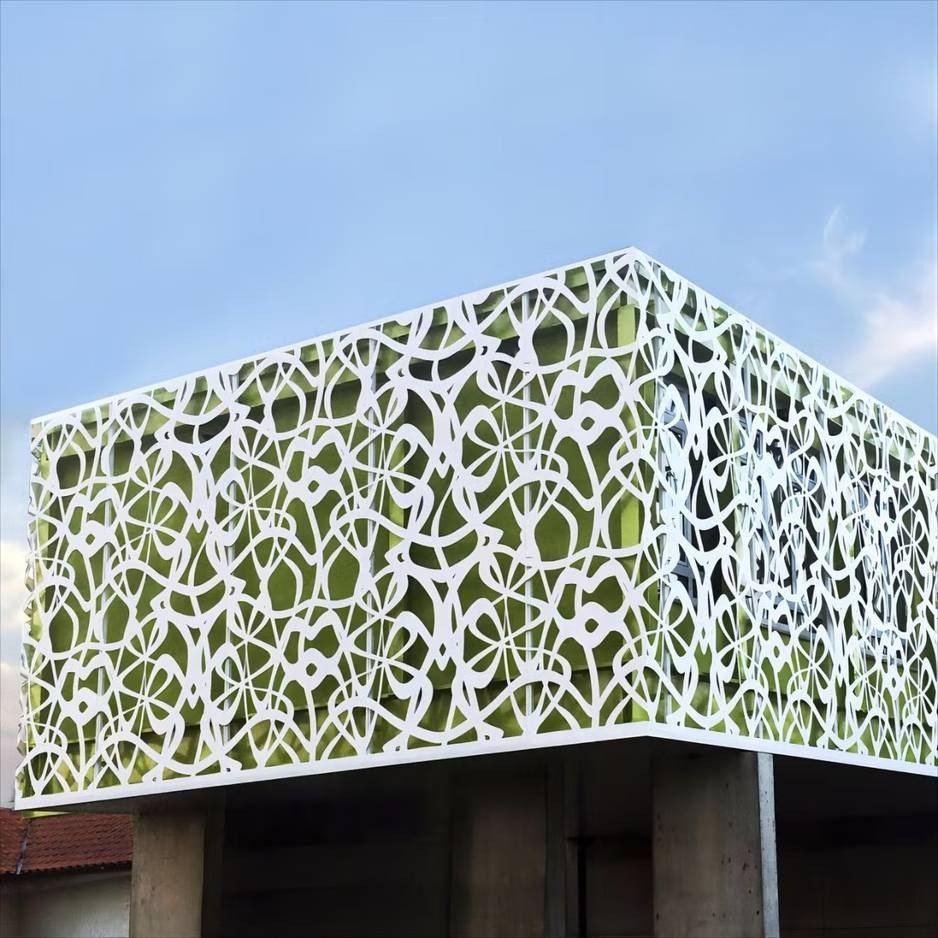
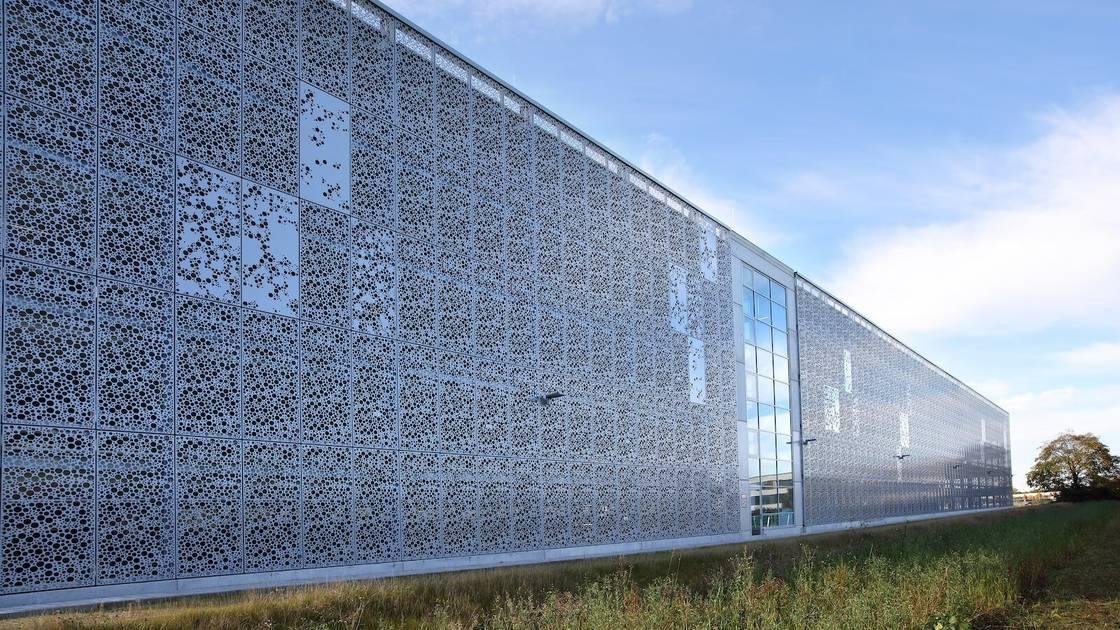
Finish selection directly influences durability, heat load, and appearance. Fluoropolymer coatings (PVDF/FEVE) offer superior UV stability, color retention, and chemical resistance—key in sandy, high-UV environments. Demand coating thickness specifications (20–30 µm for PVDF) and request accelerated QUV testing reports (1,000–2,000 hours baseline). High SRI (Solar Reflectance Index) and low absorptance finishes reduce surface temperature and associated heat transmission to the structure below. Consider specifying PVDF with SRI values above 30–40 for light colors to measurably reduce façade temperature, or include perforated shading panels with 25–40% open area to reduce direct solar gain while preserving daylight.
aluminum facade Middle East: Design considerations and detailing
Wind loads, sand abrasion, and anchorage strategies
High-rise developments face both static wind pressures and particulate-driven abrasion. Use stainless steel anchors in exposed locations and corrosion-resistant connection designs. Anchors and brackets should be detailed to minimize exposed horizontal ledges where sand can accumulate, and incorporate replaceable cover plates on the windward side to serve as sacrificial elements. For calculation, use local code wind pressure values or perform site-specific wind tunnel studies for irregular geometries; typical design pressures for tall towers in Riyadh can exceed ±1.2 kPa at high elevations.
Sand mitigation techniques and material protections for aluminum facade Middle East
Design to keep abrasive sand out of seals and drainage paths. Employ labyrinth seals, deeper gasket covers, and non-porous backing elements. Consider secondary sacrificial skins or ceramic-infused coatings on ground-level or podium façades where sand-blast exposure is greatest. Detail horizontal transitions so they slope to shed sand and water, and avoid recessed cavities greater than 20 mm where fines can accumulate and abrade finishes.
Water management and thermal break integration
Even arid environments need positive drainage. Pressure-equalized rainscreen design helps prevent water ingress during rare storms and limits capillary suction that can trap sand. Incorporate thermal breaks in framing to reduce conductive heat transfer; break materials should meet local fire and structural codes while maintaining long-term creep resistance under load. Thermal break materials like glass-reinforced polyamide of appropriate cross-sectional geometry can reduce linear thermal bridging and improve whole-wall U-values by 10–30% depending on assembly.
Installation and practical guidance for aluminum facade Middle East
Pre-installation QA/QC and mock-ups for aluminum facade Middle East
A rigorous QA program prevents costly field failures. Require mill test reports (MTRs), coating batch certificates, and full-scale shop drawings. Execute a shop-fabricated mock-up (minimum 2x2m) that includes fixed and movement details, corner conditions, gasket types, and fastener finishes. Mock-ups should be subjected to site-specific tests—water infiltration, solar reflectance checks, and abrasion simulation if possible. Clarify acceptance criteria and record results to attach to final handover documentation.
Field installation best practices and quality control
Field teams must follow torque specifications, use calibrated sealant guns, and protect finishes during handling. Installations should maintain thermal gap allowances, use non-staining backer rods, and apply sealants with manufacturer-recommended tooling to ensure consistent adhesion. Implement a hold point process where a third-party inspector approves critical alignment and anchorage before panel installation continues. Use temporary protective films only when non-abrasive and remove them promptly to avoid adhesive residue that traps sand and promotes micro-abrasion.
Commissioning, testing and handover for aluminum facade Middle East
Perform air and water infiltration tests (ASTM E283 and AAMA 501.1 or local equivalents) after portions of façade are complete. Thermal performance verification should include U-value confirmation against design targets and IR thermography to spot thermal bridges. Create a handover package that includes MTRs, coating certificates, mock-up sign-off, spare part lists, and a maintenance plan tailored for desert conditions—this package is essential for warranty enforcement and long-term asset management.
Performance, maintenance and lifecycle considerations for aluminum facade Middle East
Maintenance regimes for high-sand environments
Create a maintenance schedule tailored to local exposure. High-sand regions often require low-pressure freshwater rinses quarterly and thorough inspections annually. Use soft brushes and non-abrasive detergents; pressure washing must be controlled to avoid damaging sealants or coatings. Track maintenance costs as part of a lifecycle analysis to justify higher initial spec choices like PVDF coatings or sacrificial covers. Include measurable KPIs such as frequency of gasket replacement, number of surface repairs per 1000 m² per year, and average cleaning cost per m².
Durability metrics and expected service life
Well-specified PVDF-coated systems with correct detailing can exceed 25–30 years of effective service, although mechanical components (gaskets, fasteners) typically require periodic replacement. Specify allowable color variance (ΔE ≤ 2 over 5 years) and adhesion retention percentages. Require suppliers to provide accelerated weathering and Taber abrasion results as objective acceptance criteria. Incorporate periodic performance audits into the facility management plan to capture degradation trends early.
Manufacturing and quality control best practices
Work with suppliers who maintain ISO 9001 quality systems and traceable lot control for alloys and coatings. Implement random coating thickness checks (micrometer or non-destructive methods), salt spray tests for components exposed to saline conditions, and adhesion testing (ASTM D3359) as part of factory acceptance. Insist on documented corrective actions for any non-conforming batches before shipment. For critical projects, specify third-party witnessed factory acceptance tests and include shipment hold points until QA records are approved.
Specifier recommendations and procurement checklist
Actionable checklist for specifiers (step-by-step)
Confirm local climate data (design Tmax/Tmin, wind, sand event frequency).
Require alloy and finish selection with test evidence (MTRs, QUV, Taber).
Specify movement joint strategy and thermal expansion allowances on drawings.
Mandate on-site full-scale mock-up approval before mass production.
Include maintenance schedule and lifecycle cost estimates in the tender documents.
Insist on supplier ISO 9001 certification and documented QA/QC processes.
Define warranty terms with measurable acceptance and failure criteria.
Procurement language and measurable acceptance criteria
Include explicit acceptance thresholds: coating thickness (µm), ΔE color thresholds, adhesion pass rates, and delivery documents (coating certificates, MTRs, batch numbers). Tie final payment milestones to completion of defined tests and mock-up sign-off to enforce quality. Require spare parts and a minimum number of replacement gaskets/fixings to be supplied with initial delivery to simplify early maintenance and reduce lead times.
Comparison: Coating options for aluminum facade Middle East
When to choose each finish
PVDF/FEVE is the default for long-life, low-maintenance applications where color retention is essential. Anodized finishes are suitable for high-wear vertical façades with lower color variability. Ceramic coatings are appropriate where extreme abrasion is expected, such as podiums or ground-level screens.
Trade-offs and lifecycle cost considerations
PVDF offers longer intervals between re-coating but costs more upfront. Anodized systems can be more economical initially but may require higher maintenance if color change is critical. Include a lifecycle cost model in the tender showing 30-year projected maintenance and re-coating scenarios to guide decisions.
Finish Type
Abrasion Resistance
UV/Color Retention
Typical Lifetime
PVDF/FEVE (fluoropolymer)
High
Excellent
20–30 years
Anodized
Moderate
Very Good
25+ years
Ceramic coating
Very High
Excellent
15–25 years
Powder coat (standard)
Moderate
Moderate
10–15 years
Case example: Hypothetical office tower in Riyadh, Saudi Arabia
Project brief and challenges
A 25-storey office tower in Riyadh required a lightweight, thermally efficient façade with minimal maintenance over a 30-year horizon. Challenges included roof-surface temperatures exceeding 70°C, frequent sandstorms, and strict energy-efficiency targets.
Design and procurement solution and performance
The design team selected AA6063 extrusions with PVDF-coated perforated shading panels and a pressure-equalized rainscreen cavity. Procurement required full sample approval, MTR submission, and QUV/Taber test reports. Shop mock-ups were installed and tested on-site for water infiltration and abrasion resistance prior to full production. Post-installation thermography showed a 22% reduction in peak façade surface temperatures on shaded elevations and modeled HVAC peak load reductions of 12–18% for the conditioned zones behind the ventilated rainscreen.
Addressing common objections and concerns
Durability and abrasion concerns
With correct alloy, coating, and detailing, aluminum facades perform reliably. Combine PVDF finishes, sacrificial covers, and predictable replacement cycles. Require abrasion test data and validate with field mock-ups to mitigate risk.
Thermal movement and detailing worries
Design for thermal movement with sliding fixings and expansion joints sized to expected ΔT. Use project-specific calculations to size joints; a 20 m horizontal run at 40°C ΔT could expand nearly 18–19 mm without accommodation.
Closing recommendations
Procurement next steps
Prioritize suppliers with ISO 9001 quality systems and documented test evidence. Include mock-up sign-off and third-party witnessed factory tests as contract conditions. Set payment milestones tied to test outcomes and sample approval.
Ongoing monitoring and KPIs
Establish KPIs: gasket replacement intervals, number of repairs per 1,000 m² annually, color ΔE measurements, and average cleaning cost per m². Integrate performance audits into the facility management cycle to identify degradation early and trigger planned interventions.
FAQ
What is the best alloy for aluminum facade Middle East projects?
AA6063 and AA6005 are good choices for extrusions and framing; AA5052 and AA3003 are typical for panels. Always require MTRs and match alloy to structural needs for aluminum facade Middle East applications; correct temper and section sizes reduce deflection and long-term creep risks.
How often should maintenance occur on Middle East facades?
Inspect every 6–12 months; high-sand areas often need quarterly rinses and annual detailed checks. For aluminum facade Middle East systems, replace gaskets every 5–10 years and track surface condition to plan lifecycle repairs.
Are PVDF finishes adequate against sand abrasion?
PVDF offers excellent UV and chemical resistance; combined with tested thickness and abrasion values, it works well. For severe abrasion, augment PVDF with sacrificial covers or ceramic options on aluminum facade Middle East projects.
What tests should be requested from suppliers?
Request ASTM D3359 adhesion, QUV accelerated weathering, Taber abrasion, salt spray where relevant, and coating thickness records. These tests demonstrate aluminum facade Middle East product suitability under desert stressors.
Can aluminum facades meet Saudi building energy codes?
Yes—using high-reflectance coatings, thermal breaks, and integrated shading. Validate with lab U-value tests and energy modeling to confirm compliance on Saudi Arabia projects.
Looking for custom-designed ceilings, walls, or facades to elevate your project? Explore PRANCE Design’s integrated design and manufacturing solutions, and create the perfect fit for your architectural needs today!


 Aluminum’s linear thermal expansion coefficient (~23–24 µm/m·°C) requires explicit movement strategies on long façades. In Riyadh or Dammam, surface differentials between shaded and sun-exposed elevations frequently exceed 40°C. Design guidelines include sliding clips, elongated fastener slots, and expansion joints at regular intervals (usually every 6–12 meters depending on panel length and expected ΔT). Structural calculations should model cumulative expansion, and finite element analysis (FEA) is advised for long-span mullions. For example, a 10-meter run of aluminium can lengthen by roughly 9–10 mm when exposed to a 40°C temperature swing—this is predictable and must be accommodated in fixings.

 Design to keep abrasive sand out of seals and drainage paths. Employ labyrinth seals, deeper gasket covers, and non-porous backing elements. Consider secondary sacrificial skins or ceramic-infused coatings on ground-level or podium façades where sand-blast exposure is greatest. Detail horizontal transitions so they slope to shed sand and water, and avoid recessed cavities greater than 20 mm where fines can accumulate and abrade finishes.

 Perform air and water infiltration tests (ASTM E283 and AAMA 501.1 or local equivalents) after portions of façade are complete. Thermal performance verification should include U-value confirmation against design targets and IR thermography to spot thermal bridges. Create a handover package that includes MTRs, coating certificates, mock-up sign-off, spare part lists, and a maintenance plan tailored for desert conditions—this package is essential for warranty enforcement and long-term asset management.
 Work with suppliers who maintain ISO 9001 quality systems and traceable lot control for alloys and coatings. Implement random coating thickness checks (micrometer or non-destructive methods), salt spray tests for components exposed to saline conditions, and adhesion testing (ASTM D3359) as part of factory acceptance. Insist on documented corrective actions for any non-conforming batches before shipment. For critical projects, specify third-party witnessed factory acceptance tests and include shipment hold points until QA records are approved.