Introduction

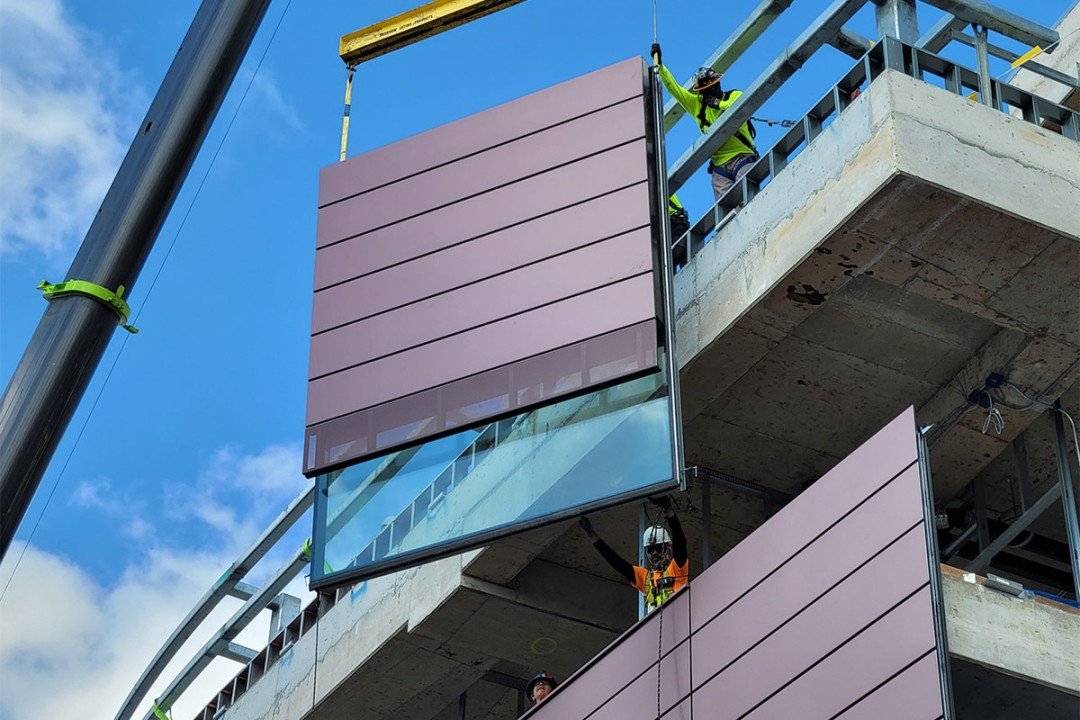
Curved aluminum panels are transforming contemporary façades and interiors by enabling free-form geometries, streamlined aerodynamics, and distinctive visual language. Architects and façade engineers increasingly specify curved and hyperbolic aluminum panels to achieve iconic shapes while maintaining lightweight performance and durability. This article explains technical design drivers, fabrication techniques, site installation guidance, and maintenance practices, with actionable recommendations for specifiers and contractors working in the UAE and similar climates.
Design Considerations for Curved Aluminum Panels

Curved aluminum panels: thickness, alloy, and panel system selection
Choosing the right alloy (commonly 5005-H34, 5754 or 3003 for bending; 6061-T6 for structural elements) and panel thickness is critical. Thinner gauges (0.7–1.5 mm) are easier to form but may require backing or stiffeners to meet deflection limits. For façades exposed to wind loads in the UAE, specify minimum yield strength and consider insulated panel assemblies for thermal performance. Establish allowable deflection ratios (L/180 or L/240 depending on cladding type) early in the design stage.
Bending radius and curvature constraints for curved aluminum panels
Minimum bend radius depends on alloy and temper: typical cold-bendable alloys tolerate a radius of 1.5–3× material thickness for tight curves; for more complex or hyperbolic forms, consider stretch-forming or hydroforming. Panel joint geometry, panel length, and fastener spacing influence achievable radii. Provide panel patterns and digital nested layouts (DXF/CAM files) to the fabricator so CNC nesting and bending simulation can validate geometry before production.
Joint design and visual outcomes
Joint design determines the visual continuity of a curved façade. Overlapping standing seams hide fasteners but complicate curvature, whereas flush butt joints give a seamless look at higher fabrication cost. Consider reveal widths, drainage paths, and backer profiles when selecting a joint system. Mock-ups are essential to finalize tolerance zones and visual acceptability.
Fabrication Techniques for Curved Aluminum Panels and Hyperbolic Forms

Cold bending, roll-bending, and CNC brake forming
Cold bending and roll-bending are cost-effective for simple cylindrical or conical curves. Roll-bending machines create continuous curvature for long runs; CNC brakes enable precise bends for segmented panels. Control springback through over-bending parameters programmed into CNC machinery. For repeatability, document tooling settings, bend sequence, and part numbering.
Stretch forming, hydroforming, and freer-form methods for hyperbolic panels
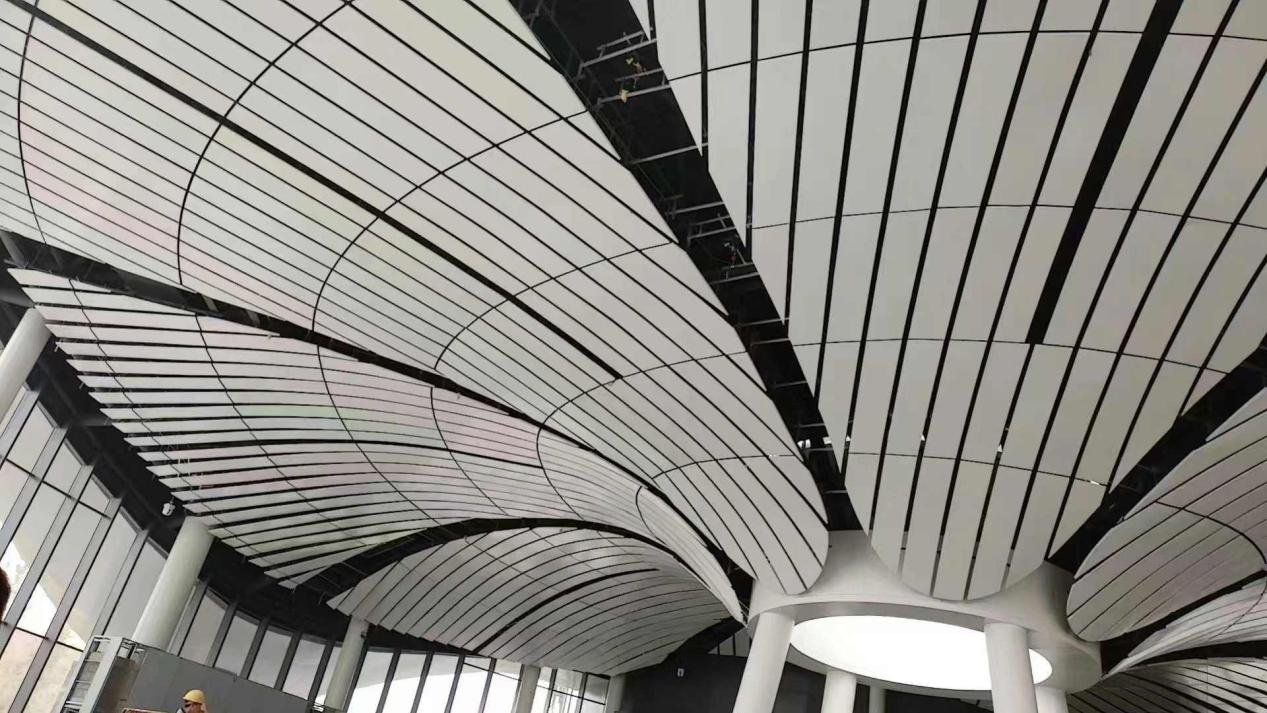
For complex hyperbolic double-curved forms, stretch forming and hydroforming produce smoother surfaces with tighter tolerances. Hydroforming uses fluid pressure to shape sheets against a die and is ideal for repeatable complex panels. Additive metal backing or internal stiffeners can be integrated in fabrication to improve flatness and attachment options.
CNC nesting, nesting efficiency and material yield
Efficient nesting reduces scrap and cost. Provide the fabricator with accurate panel patterns and establish kerf allowances. Where possible, design repetitive modules suitable for efficient nesting to lower per-unit fabrication cost. Ask for nesting layouts during the tender stage to confirm material yield.
Manufacturing quality control best practices
Implement ISO-aligned QC checkpoints: incoming material certificates, dimensional checklists, coating thickness and adhesion (ASTM D3359 peel/adhesion), and salt spray testing (ASTM B117) for PVDF finishes. Track batch numbers and maintain non-conformance records. These measures reduce on-site rework and ensure panels meet performance specifications.
Site Installation Guidance for Curved Aluminum Panels
Pre-installation planning and site logistics
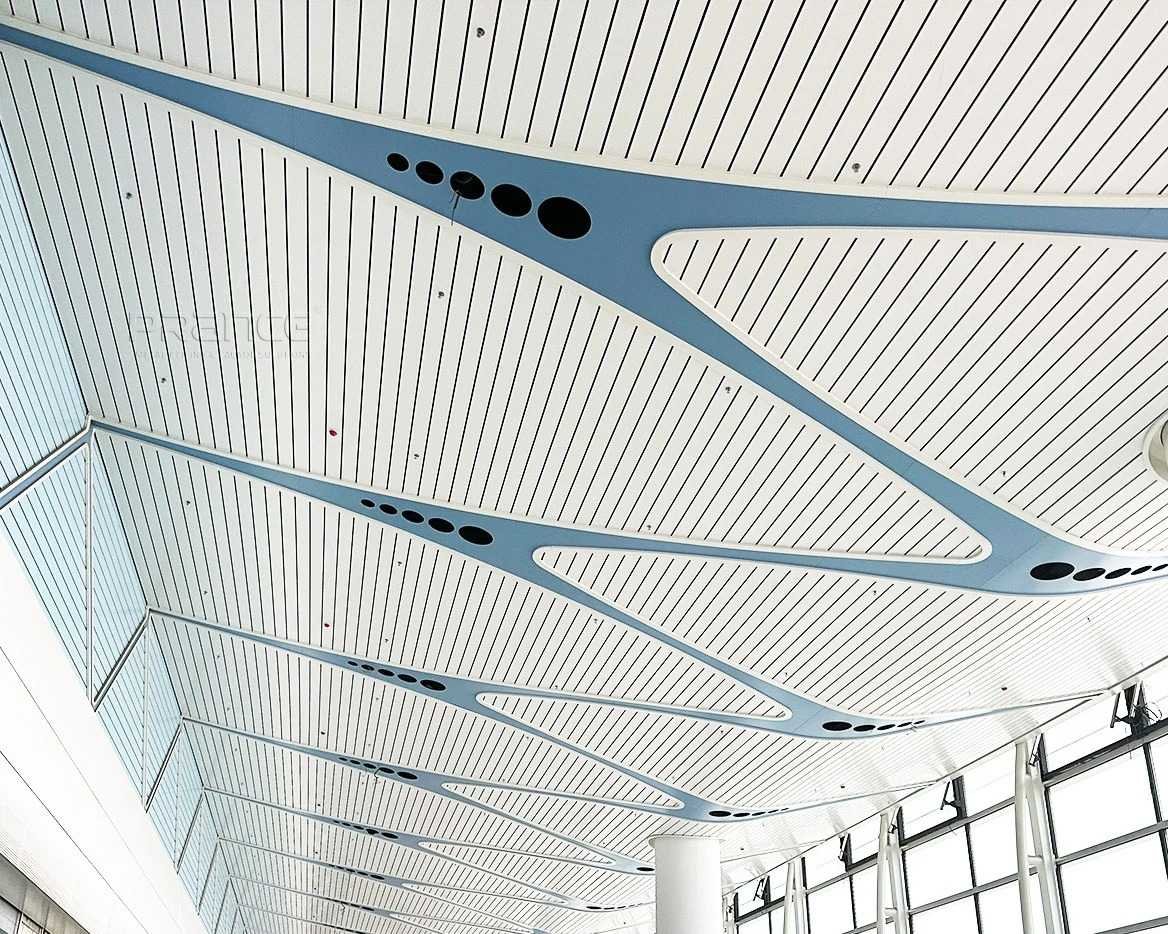
Successful installations start with precise survey data—use 3D laser scanning to confirm as-built geometry. Coordinate cranage, rigging, and temporary supports for large curved panels. In the UAE, consider midday heat management and shaded staging to avoid thermal distortion and worker heat stress.
Fixing systems, brackets, and tolerance management for curved aluminum panels
Select adjustable bracket systems (slotted or articulated brackets) to accommodate curvature and thermal movement. Use stainless steel fasteners with neoprene washers for corrosion resistance. Maintain tight tolerances: typical panel-to-panel gap ranges 6–12 mm depending on joint profile. Include expansion joints every 6–12 meters as per thermal movement calculations.
On-site handling, storage, and safety considerations
Protect pre-finished panels from scratches—store flat when possible or on padded cradles with support points matched to panel curvature. Use soft slings and suction lifters rated for panel weight. Document handling procedures in a site-specific method statement to reduce damage risk.
Performance, Maintenance, and Quality Assurance

Coatings, weathering, and test methods
PVDF and high-performance fluoropolymer finishes are industry standard for long-term color retention and UV resistance. Specify coatings with minimum film thickness and pass criteria: ASTM D523 gloss, ASTM D2244 color retention, and salt spray resistance per ASTM B117 for coastal projects in the UAE. Wind uplift, tensile strength, and anchorage pull-out tests should be performed per project structural specifications to validate façade performance.
Maintenance schedules and repair strategies for curved aluminum panels
Create a maintenance plan: visual inspections annually, wash cycles every 6–12 months depending on pollution and coastal exposure, and immediate repair of any coating breach. For dents or localized damage, panels can often be replaced as single units; design for replaceability with standardized fixings.
Durability expectations and lifecycle metrics
Expect 20–30 years of façade life for properly specified coated aluminum panels in arid climates; local factors (sand abrasion, UV intensity) will influence lifecycle. Use life-cycle costing (LCC) to compare initial fabrication costs versus long-term repainting or replacement and include expected maintenance intervals in whole-life cost models.
Project Checklist & Recommendations for Specifiers and Decision-makers
Specification checklist for curved aluminum panels
• Define alloy, temper, and minimum thickness.
• Specify bending radii and panel segmentation.
• State coating system, film thickness, and finish warranty.
• Require manufacturing QC documentation and sample approvals.
• Require as-built 3D survey deliverables and shop drawings.
Procurement, inspection, and installation step-by-step
- Issue geometric model and performance criteria to fabricator.
- Approve shop samples (full-size mock-up if possible).
- Monitor factory QC checkpoints and witness critical tests.
- Coordinate delivery windows and staged installation.
- Perform water, wind, and load verification after installation.
Risk mitigation and contractual clauses
Include acceptance criteria for dimensional tolerances, rejection thresholds for coating defects, and warranty clauses for remedial works. Define responsibility matrix for rectifying deviations discovered during site surveys.
Case Study: Curved Aluminum Panels on a Mixed-Use Façade in the UAE
Design brief and objectives
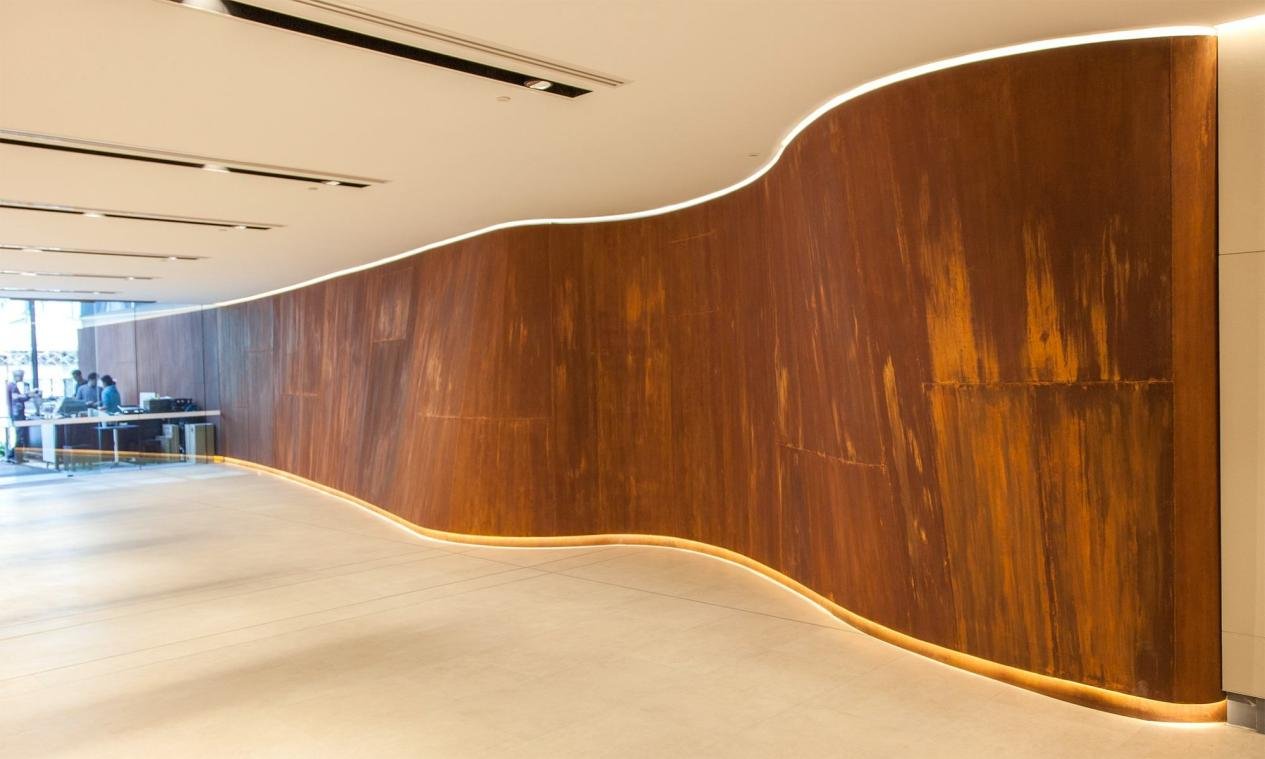
A hypothetical 20-story mixed-use tower in Dubai required a signature hyperbolic canopy wrapping the podium. The client specified curved aluminum panels with a PVDF finish and integrated backlighting. Objectives included minimal maintenance, high reflectivity control, and rapid installation to meet phased occupancy dates.
Fabrication approach and on-site execution
The fabricator used a combination of roll-bending for large cylindrical panels and hydroforming for double-curved canopy segments. CNC-nested panels with predrilled slots reduced on-site drilling. A 3D laser scan of the podium verified bracket placement; articulated stainless-steel brackets allowed ±15 mm vertical adjustment, enabling a 6-week installation window with zero panel rework.
Outcome and performance in local conditions
After two years of exposure to coastal humidity and solar loading, the façade demonstrated minimal color shift (within specified ΔE limits) and no significant coating failures. The project team attributed success to early QC sampling, specification of appropriate alloy/finish, and rigorous site method statements—practices recommended for any UAE project.
| Option | Typical Applications | Advantages | Trade-offs |
|---|---|---|---|
| Roll-bent aluminum panels | Long curved façades, continuous arcs | Cost-effective, continuous curvature | Limited to single-curvature forms |
| Hydroformed curved aluminum panels | Complex double-curved forms | Smooth surface, tight tolerances | Higher tooling cost; better for repeats |
| Segmented CNC-bent panels | Irregular geometries, on-site adjustability | Lower tooling cost, flexible | Visible seams; requires precise installation |
Addressing common objections and concerns
Objection: “Curved panels add too much cost.” Response: While initial fabrication costs rise, optimized segmentation and choice of forming method (roll-bend vs hydroform) can reduce costs. Use LCC to demonstrate payback via lower maintenance and faster installation.
Objection: “Thermal movement will warp panels.” Response: Properly designed expansion joints, adjustable brackets, and allowance for thermal expansion (calculate ΔL = α·L·ΔT) mitigate movement issues—use 25–40°C design temperature swings for UAE calculations.
Objection: “Coating will fail under sand and UV.” Response: Specify PVDF with proven accelerated weathering data, require adhesion and salt spray testing, and implement scheduled washing to extend lifecycle.
Actionable recommendations (quick checklist)
• Start with a digital model and 3D scan; lock geometry before fabrication.
• Require full-size mock-up for critical visual conditions.
• Specify alloy, thickness, and coating test criteria in contract documents.
• Define tolerances and acceptance criteria for panel flatness and edge conditions.
• Include factory QC witness points and deliverables (material certs, test reports).
FAQ
Q1: How tight a radius can I get with curved aluminum panels?
A1: Minimum radius depends on alloy and temper; many common alloys can achieve 1.5–3× material thickness by cold bending. For tighter radii or double curvature, use stretch or hydroforming methods. Discuss target radius with your fabricator and request a sample to validate formability. This ensures the curved aluminum panels meet visual and structural expectations.
Q2: Are curved aluminum panels suitable for UAE coastal environments?
A2: Yes—curved aluminum panels with PVDF finishes are widely used in the UAE. Specify salt spray resistance (ASTM B117) and adhesion criteria; schedule regular wash cycles to mitigate salt and sand abrasion. Correct alloy selection and coating system are key to longevity in coastal climates.
Q3: What coatings extend curved panel life the most?
A3: High-quality PVDF (70% PVDF) fluoropolymer systems offer the best long-term color and chalk resistance. Ensure minimum dry film thickness and confirm accelerated weathering test results with the manufacturer. Coating choice directly impacts the performance of curved aluminum panels in high-UV environments.
Q4: Can damaged curved panels be repaired on-site?
A4: Minor dents and localized coating damage can sometimes be repaired; however, designing panels for replaceability is best. Standardized fixings and accessible brackets make panel replacement straightforward without affecting adjacent units. Replacement minimizes downtime and preserves the integrity of curved aluminum panels assemblies.
Q5: What tests should fabricators perform before delivery?
A5: Fabricators should provide material certificates, dimensional inspection reports, coating adhesion tests (e.g., ASTM D3359), and salt spray (ASTM B117) results for coated panels. These QC steps reduce on-site discovery of defects and confirm that curved aluminum panels meet project specifications.