

In many commercial projects, the ceiling becomes one of the first design elements affected by value engineering. A carefully developed concept can quickly lose impact when material substitutions reduce texture, depth, or visual continuity. For architects and interior designers, preserving the original ceiling intent often becomes a balancing act between aesthetics, performance, and budget. That is why metal ceiling finishes matter. They help teams protect the design idea while keeping the ceiling buildable, durable, and easy to maintain.
This guide shares 6 different ceiling finish types for commercial interiors. Each option shows how metal ceiling finishes can solve a specific design problem.
Why Metal Ceiling Finishes Matter in Commercial Interiors
In commercial interiors, ceiling design influences how people perceive scale, brightness, and spatial hierarchy. A reflective finish can increase the perceived openness of a lobby, while a low-glare surface may improve visual comfort in workspaces and educational environments.
It can also make the same space feel cheap when the finish looks flat or inconsistent. That is why ceiling finishes should be treated as an architectural decision, not a last-minute product choice.
In WELL-oriented projects, ceiling surfaces support sound control, and light design supports visual comfort. WELL’s sound guidance asks teams to use absorptive ceiling surfaces where noise matters, while its light guidance links interior lighting to visual acuity and circadian support.
BREEAM promotes circularity, and aluminum fits that model because it can be recycled repeatedly without losing its basic properties. For commercial owners, that gives Metal ceiling finishes a clear advantage over finishes that age poorly or demand frequent repair.
Top 6 Metal Ceiling Finishes for 2026
1. Powder-Coated Finishes
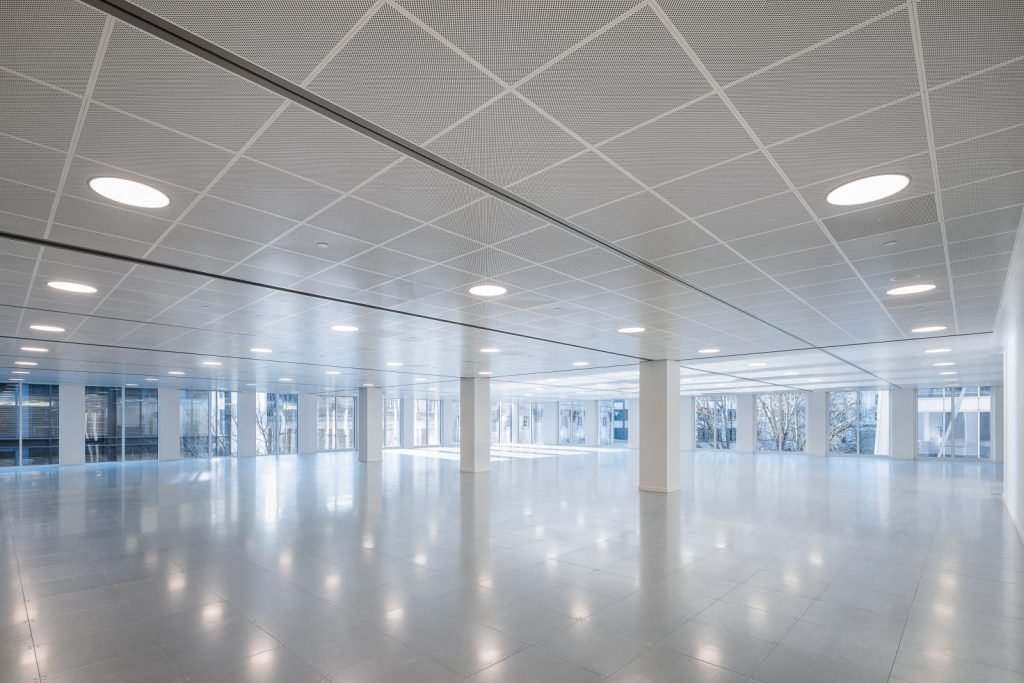
Powder-coated surfaces remain one of the most versatile metal ceiling finishes. The process uses electrostatic application of dry powder that cures under heat, which helps produce a consistent surface across panels and baffles.
In 2026, the design direction is clear. Teams want matt, ultra-matt, and textured satin surfaces that reduce glare and feel more architectural under mixed lighting. This finish works well in open-plan offices, co-working areas, and education projects. It also supports strong color matching, so the ceiling can reinforce a brand without distracting from the interior composition.
2. Anodized Finishes

Anodized aluminum keeps the metal visible, which is why it stays high on the list of ceiling finish ideas for lobbies, lounges, museums, and executive areas. The Aluminum Association defines architectural anodizing as a finish for permanent exterior and static applications where both appearance and long life matter. That makes anodized surfaces useful when the brief needs a real metallic read rather than a painted imitation. Champagne, titanium, bronze, and architectural silver all work well. The finish feels quiet, precise, and durable. It also keeps its identity under strong daylight better than many soft decorative surfaces.
3. Pre-Coated / Roller-Coated Finishes

For large projects, pre-coated metal is one of the most practical metal ceiling finishes. Coil coating IS a continuous, automated process that cleans, treats, paints, and recoats metal before fabrication. And steel, galvanized steel, and aluminum are common base materials of this surface finish.
That consistency matters in airports, transit hubs, mega-malls, and convention centers. These projects need the same visual result across long spans and many bays. Pre-coated surfaces reduce batch variation and support brushed-look or subtle metallic effects with better repeatability than many hand-applied methods.
4. Wood & Stone Grain Finishes
Natural timber remains a popular material in hospitality and wellness projects, but maintenance concerns often limit its use in large public spaces. Wood-grain metal ceiling finishes provide a practical alternative, allowing designers to achieve the visual warmth of oak, walnut, or teak while retaining the dimensional stability of aluminum.
That matters because the ceiling still resists warping and moisture issues better than many natural materials. It also gives designers more freedom to use curves, coffers, or layered patterns without the weight and maintenance concerns of timber or stone. When the project needs comfort and control in the same surface, this option performs well.
5. Mirror Finishes

Mirror finishes create spatial drama through reflection. They can raise the perceived height of a room, stretch a corridor, or make feature lighting feel stronger. That is why mirrors sit among the most striking ceiling finish types for luxury retail, hotel atriums, nightlife venues, and selected feature zones.
The key is restraint. Mirror works best in focused areas, not across every square meter. Used carefully, it gives a ceiling a futuristic edge and turns light into part of the architecture. Used poorly, it creates visual noise.
6. PVDF / Fluorocarbon Coatings

PVDF / fluorocarbon coatings are the right choice when the ceiling faces sun, pollution, moisture, or outdoor spillover. Coil-coating sources describe these systems as factory-applied coatings used for metal that needs durable color and strong environmental resistance.
That makes them suitable for semi-outdoor plazas, open atriums, subway entrances, and coastal developments. In practical terms, they help the ceiling keep its color and visual stability longer, where ordinary interior finishes would struggle.
The Designer’s Selection Criteria: Aligning Finish with Application
Selecting Metal Ceiling Finishes involves more than appearance. Lighting conditions, building function, maintenance requirements, and environmental exposure all influence long-term performance and user experience.
Design for Light Before Color
A finish sample rarely behaves the same way once installed. Anodized and mirror surfaces can increase brightness and spatial depth, while matt powder-coated and wood grain finishes often provide better glare control in workspaces and educational environments.
Let Building Function Guide the Finish
The ceiling should support the purpose of the space. Corporate interiors often favor restrained metallic finishes, while hospitality and wellness projects frequently benefit from warmer textures and lower reflectance levels.
Consider Long-Term Maintenance
Maintenance requirements vary significantly between finish types. Highly reflective surfaces typically require more frequent cleaning, while textured finishes can better conceal minor marks and day-to-day wear.
Match the Finish to the Environment
Interior and semi-outdoor spaces place different demands on ceiling systems. Exposure to humidity, sunlight, pollution, or coastal conditions should influence finish selection from the beginning of the design process.
Combining Multiple Metal Ceiling Finishes for Better Design Effect

Many successful commercial interiors use more than one finish. Designers increasingly treat the ceiling finishes as a zoning tool rather than a single building-wide specification. Different finishes can signal changes in function, circulation, or brand experience while keeping the ceiling language visually coherent.
|
Zone |
Typical Finish |
Design Intent |
|
Arrival lobby / executive reception |
Anodized bronze, champagne, or silver |
Emphasize permanence, precision, and material authenticity. |
|
Open office / classroom / co-working |
Matt powder-coated finish |
Reduce glare and support visual comfort under linear lighting. |
|
Hospitality lounge / wellness / library |
Wood grain metal ceiling finish |
Introduce warmth without the movement and maintenance issues of natural timber. |
|
Retail feature zone / atrium accent |
Mirror finish used selectively |
Create reflection, depth, and a focal point without overwhelming the space. |
The key is not the number of finishes but the transitions. Finish changes should align with architectural boundaries such as bulkheads, circulation nodes, tenant demarcations, or lighting breaks. Random transitions tend to look like late-stage substitutions rather than intentional design decisions.
Design Teams also need to coordinate reflectance levels. A mirror finish adjacent to a very low-sheen powder-coated ceiling can create abrupt brightness contrast. Many designers manage this by stepping through intermediate textures, for example, satin anodized → matt powder coat → wood grain, instead of jumping directly from highly reflective to highly absorptive surfaces.
FAQ
Can Metal Ceiling Finishes work in humid semi-outdoor spaces?
Yes, but the finish must match the exposure level. For humid or semi-outdoor areas, PVDF / fluorocarbon coatings are often the safer choice because they are made for harsher conditions. The ceiling system also needs careful detailing at edges, joints, and penetrations so moisture does not collect in weak points. In these projects, the finish and the assembly should be selected together, not separately.
How do I keep maintenance access without losing a clean ceiling look?
Use a modular ceiling layout. That lets the design team place access points where maintenance crews can reach services without breaking the visual rhythm. The best Metal Ceiling Finishes hide the access strategy well, so the ceiling still looks continuous. Good planning also helps around lights, diffusers, sprinklers, and sensors. A clean ceiling is not one with no access. It is one where access is intentional.
Is a wood finish metal ceiling a good choice for offices?
Yes, when the project needs warmth without the movement and upkeep of real timber. A wood finish metal ceiling can soften a corporate interior and make it feel more welcoming. It also works well with acoustic planning, because the ceiling can include perforation, baffles, or hidden support zones. That makes it a strong choice for reception areas, meeting rooms, and hospitality-style offices where mood matters.
Can these finishes be used in retrofit projects?
Yes. Retrofit projects often benefit from Metal Ceiling Finishes because they can hide old services, improve visual order, and refresh a space without major structural change. The key is early site measurement. Older buildings often have uneven slabs, shifted grids, or hidden obstacles. A finish that looks simple on paper may need careful adjustment in the field.
Which finish gives the best balance of design and ROI?
For many commercial interiors, powder-coated or pre-coated metal gives the best balance. Both provide strong visual control, broad color options, and reliable performance over time. The final choice depends on the brief. If the space needs a calm custom color, powder coating usually works well. If the project needs large-scale repeatability, pre-coated metal often wins. In both cases, metal ceiling finishes protect the design and reduce long-term maintenance pressure.
Metal ceiling finishes are design tools. They shape light, tone, and spatial identity while helping the project survive budget pressure and daily use. When the team chooses carefully, metal ceiling finishes can carry the architecture from concept to completion.


