Architectural curves look straightforward in a 3D model, but a metal curved panel has to become a real component with defined dimensions, edges, joints, and fixing points. Much of the difficulty begins in the gap between the intended surface and what can actually be fabricated and installed.
Before production, the curve must be divided into practical panel sizes, matched with the right material and forming method, and coordinated with the supporting structure. If these decisions are disconnected, smooth digital geometry can turn into difficult radii, misaligned joints, or panels that do not fit site conditions. This article will explain the main challenges in curved metal panel design and fabrication, including geometry, panelization, forming, support coordination, drawings, mock-ups, and production release.
Why Are Metal Curved Panels Difficult to Produce?

Flat metal panels are easier to control because their dimensions, edges, and connection details stay consistent. Curved metal panels are less forgiving. Geometry, forming behaviour, panel size, joint alignment, and the supporting structure all show up in the finished surface.
The main difficulties usually come from five areas:
-
- Complex curve type: A curve has to become accurate production geometry. This becomes harder when the radius changes or the panel bends in more than one direction.
-
- Forming limits: Material, thickness, radius, and forming method set practical limits on the shape that can be produced.
-
- Panelization: Larger panels mean fewer joints, but they are harder to form and handle. Smaller panels follow complex geometry more easily but add more seams.
-
- Joint and surface alignment: Even small dimensional differences can show up as uneven joints, distorted edges, or breaks in reflected light.
-
- Subframe accuracy: The supporting structure has to follow the same geometry as the panels. If it does not, installers may have to force panels into position.
That is why metal curved panels are more sensitive to design and fabrication tolerances than standard flat panels.
How Curve Geometry Affects Metal Curved Panel Fabrication
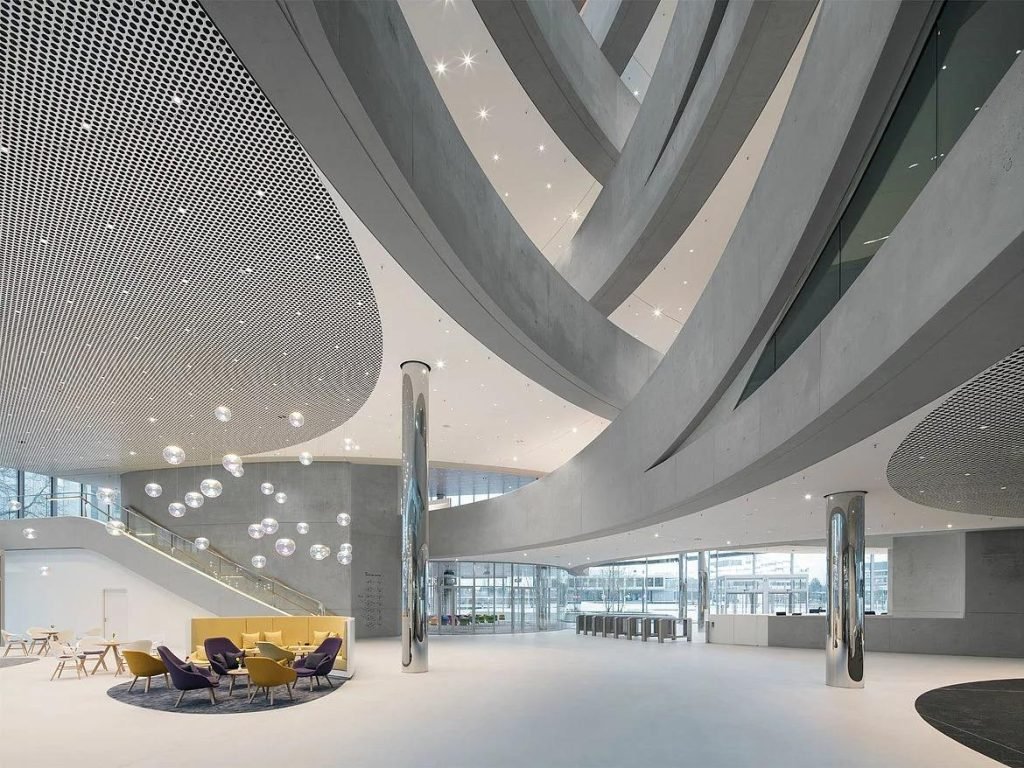
Curve geometry directly affects how a metal curved panel is formed, divided, and repeated in production.
Constant-Radius, Variable-Radius, and Compound Curves
A constant-radius curved panel bends in one direction and is easier to repeat. A variable-radius panel changes along its length, so dimensions and forming conditions may differ between panels.
Compound-curved metal panels bend in two directions and are harder to form. Simple roll bending may not achieve the required geometry, so fabrication may require specialized forming, smaller panels, or fabricated sections.
Smooth Curves vs. Faceted Metal Panels
A curved surface does not always require continuously curved panels. Flat or brake-formed metal panels can create a faceted surface, simplifying fabrication but making joints and angle changes more visible.
| Curve type | Typical fabrication method | Key consideration |
| Constant-radius curve | Roll bending | Radius and panel length |
| Variable-radius curve | Custom forming | Changing radius and panel fit |
| Compound curve | Specialized forming | Forming difficulty and surface continuity |
| Faceted surface | Flat or brake-formed panels | Joint and angle visibility |
Fabrication Limits in Metal Curved Panel Design

Once the curve geometry is fixed, fabrication limits begin to shape the panel itself. Size, material, thickness, edge details, and forming method all affect what can actually be produced.
Panel Size, Joint Layout, and Edge Details
Fewer joints are often desirable on a curved surface, but larger panels are harder to form, reinforce, transport, and lift. Breaking the surface into smaller panels makes complex geometry easier to follow, at the cost of more visible seams.
Joint layout can be just as important as panel size. Seams placed across a strong visual line can interrupt the curve, while edge returns, openings, perforations, and stiffeners may restrict forming or create local distortion.
Material, Thickness, and Achievable Radius
The achievable radius is closely tied to the material and panel thickness. Aluminum is widely used for architectural curved panels because of its weight and formability, while steel and stainless steel suit different structural, finish, or exposure requirements.
The finish also has to survive the fabrication sequence. Forming, welding, coating, and anodizing can affect one another, particularly where the panel geometry is tight or highly visible.
Choosing a Forming Method for Curved Metal Panels
Roll bending works well for many continuous single-direction curves. Faceted surfaces are more often produced with brake-formed segments. Compound forms can push fabrication toward stretch forming, press forming, specialized tooling, or fabricated sections.
Material, thickness, radius, panel dimensions, edge construction, finish, and production quantity all influence which method is practical.
How Subframe Accuracy Affects Curved Metal Panels
A metal curved panel can be fabricated to the correct radius and still install poorly if the supporting structure does not match the approved geometry. Differences in subframe radius or position can force panels out of alignment, creating uneven joints, surface distortion, or breaks in reflected light.
This makes subframe accuracy part of the finished curved surface, not just an installation detail.
From Design Review to Metal Curved Panel Production
For curved metal panels, design review cannot stop at the architectural model. The approved geometry, panel details, samples, and production information all need to stay consistent as the project moves into fabrication.
Shop Drawings and Fabrication Drawings for Curved Panels
Fabrication review often exposes problems that are easy to miss in the model, such as oversized panels, awkward transitions, unsuitable joints, or too many unique parts.
Shop drawings define the panel layout, joints, interfaces, and support arrangement. Fabrication drawings take that approved layout further, adding production dimensions, edge details, openings, stiffeners, and connection points. Both should work from the same reference model and datum.
Samples and Mock-Ups Before Batch Production
A small sample is usually enough to check material, finish, perforation, and basic forming quality. For compound geometry, prominent joints, reflective finishes, complex interfaces, or unfamiliar support details, a full-scale mock-up gives a much clearer picture of how the panels will actually come together.
Trial assembly is most useful when it focuses on the difficult area rather than a simple repeat condition. Curve continuity, adjacent panel fit, joint width, edge alignment, finish direction, and visible surface variation can then be checked before batch production.
From Curved Panel Design to Fabrication

The main challenge with metal curved panels is not bending the sheet itself. The difficulty lies in turning architectural geometry into panels that can be formed accurately, joined cleanly, and installed on a supporting structure that follows the same curve.
Panel geometry, material and thickness, forming method, joint layout, and subframe accuracy all affect the final result. Resolving these limits before batch production reduces the risk of distorted panels, uneven joints, or a finished surface that no longer matches the original design.
For projects with complex curved geometry, keeping design review, fabrication drawings, mock-ups, production, and installation support within one coordinated process can reduce gaps between the original concept and the finished metalwork. If you are developing a curved metal ceiling, wall, or facade, send PRANCE design team with your available 2D drawings or 3D model for an early fabrication review.
FAQs
Can perforated metal panels be curved?
Yes. Perforated metal panels can be curved, but the hole size, open area, perforation pattern, panel thickness, curve radius, and forming method all affect the result. Tight forming can distort openings or change spacing, so a sample panel is useful before production.
Do Metal Curved Panels Require Custom Tooling?
No. Many constant-radius curved panels can be produced with adjustable rolling equipment and repeatable settings. Custom jigs or tooling are more likely for compound curves, tight radii, unusual edge details, or large quantities of identical parts.
Can a metal curved panel be made to any radius?
No. The achievable radius depends on the material, panel thickness, panel size, edge construction, and forming method. Tighter or more complex curves may require specialized forming, smaller panels, or changes to the original geometry.