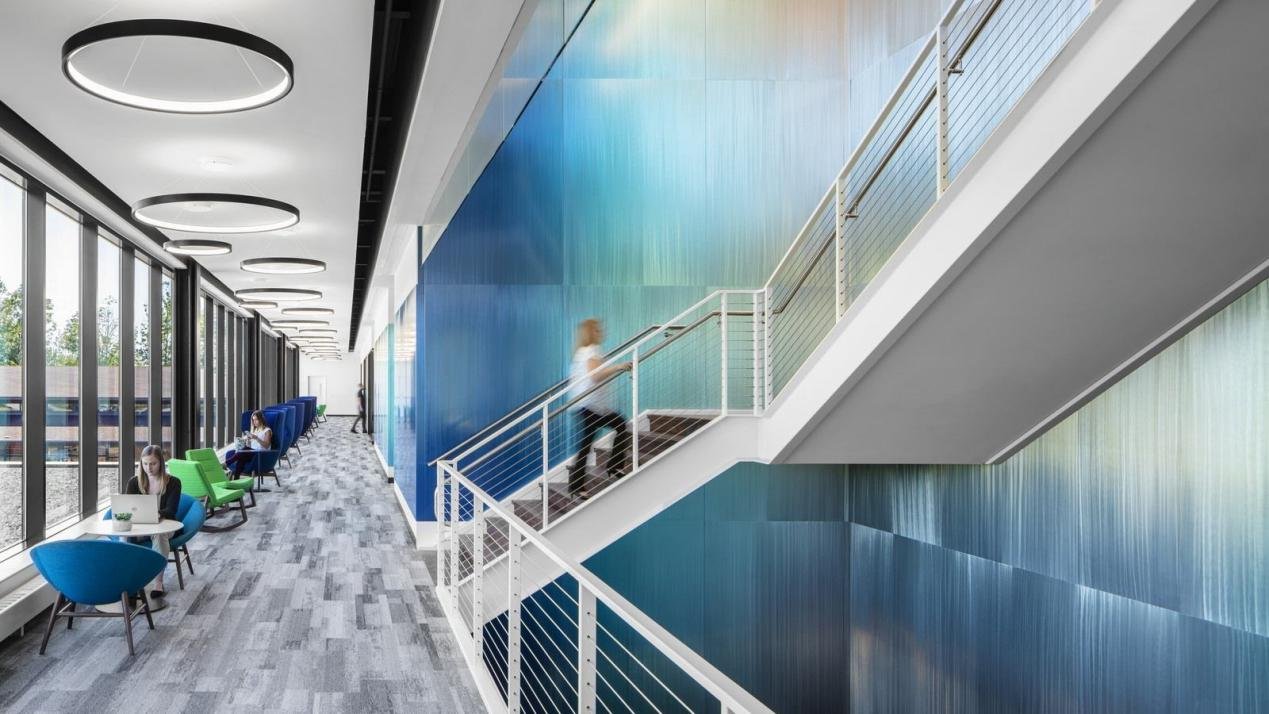
A reception wall design calls for backlit laser-cut metal panels, but the drawings leave out what sits behind the openings. Without a defined backing, supporting frames and wall services may remain visible through the pattern. Similar issues arise when deep 3D textures extend into narrow corridors or large decorative patterns are repeated across an entire lobby wall.
Choosing a decorative metal wall panel involves more than its surface appearance. This guide compares solid, perforated, laser-cut, textured and metal mesh panels, covering their design possibilities, lighting effects, materials, finishes and applications in commercial interiors and exterior accent walls.
Types of Decorative Metal Wall Panels
Solid Metal Panels

Solid metal panels have an unperforated face that completely conceals the wall behind them. They work well for reception signage, corridor cladding and interiors that require a continuous, opaque surface.
Without openings or decorative cutouts, the appearance depends mainly on the color, surface finish, panel proportions and joint layout. A flat decorative metal wall panel also creates a quieter background where furniture, branding or surrounding materials already attract attention.
Perforated and Laser-Cut Panels

Perforated metal wall panels typically use repeated holes or slots to create a consistent surface pattern. Laser-cut metal wall panels allow more varied designs, including geometric compositions, logos and custom motifs. Both methods can produce repeating patterns, but larger custom cutouts generally create a more recognizable graphic.
Opening size and pattern density affect how much of the background remains visible. Small, closely spaced openings can appear as a continuous texture, while larger cutouts make the background part of the design.
A dark backing can emphasize the pattern, and backlighting can make the openings more prominent. If supporting frames or wall services must remain concealed, use an opaque backing or consider a solid panel instead.
Textured and 3D Metal Panels

Textured metal wall panels include shallow embossed surfaces, folded profiles and sculpted forms. Shallow textures add surface detail without creating large projections, making them suitable for corridors and walls viewed at close range.
Deeper 3D profiles produce stronger light and shadow. They are better suited to reception backdrops and larger focal walls where the full profile can be appreciated from a distance.
Check the projection depth before using sculpted panels beside seating or narrow circulation routes. Deep recesses may also require more cleaning effort than flat or lightly embossed surfaces.
Woven and Expanded Metal Mesh Panels
Metal mesh panels create an open decorative surface using woven wire or expanded metal. Woven mesh has an interlaced wire structure, while expanded metal forms connected strands with a pattern that often appears directional.
Unlike perforated sheets, which retain a relatively continuous metal face around individual openings, mesh creates a more visibly open layer. It suits decorative screens and layered wall treatments where the background is intended to remain partially visible.
A dark background can make the metal pattern stand out, while exposed supporting elements may become part of the overall appearance. Select the mesh and its backing together rather than treating the metal surface as an independent finish.
Decorative Metal Wall Panel Design Considerations
Choosing Between Repeating Patterns and Custom Graphics

Use geometric patterns for a consistent appearance across long wall surfaces. Linear patterns can emphasize a wall’s height or length, while organic motifs and custom graphics work better as focal points in reception backdrops or branded interiors.
A bold graphic might look right on an accent wall but compete with signage, merchandise or surrounding finishes when repeated throughout a space. For continuous corridor cladding, a simpler pattern can maintain visual consistency without drawing attention away from other architectural elements.
Finish Selection Beyond Color
For exterior decorative metal wall panels, PVDF coatings are a common option where weather resistance and color retention matter. Pre-coated aluminum offers a factory-applied finish with consistent color across repeated panels, but confirm compatibility with the intended bending and cutting processes, particularly at exposed edges. PVDF describes a coating type, while pre-coating describes when the coating is applied; the two are not mutually exclusive.
Wood-grain transfer finishes introduce another consideration: grain direction. Adjacent panels should follow the intended grain orientation, especially around corners and across large wall sections. Brushed metal also has a directional texture, so inconsistent panel orientation can become noticeable even when the color matches. Solid colors avoid the need to coordinate a printed grain pattern, but gloss and surface texture still affect the result.
Lighting can expose differences that are less obvious on individual samples. Light directed across textured or 3D metal panels emphasizes folds and recesses, while frontal illumination makes the profiles appear flatter. Reflective finishes may also reveal differences between adjacent panels more clearly than matte finishes.
Where to Use Different Decorative Metal Wall Panels
For a decorative metal wall panel, the first consideration is whether the wall needs an opaque backdrop or an open decorative surface. In busy public areas, contact exposure and panel projection can also influence the selection.
| Application | Recommended Panel Selection |
| Reception and lobby walls | Solid or shallow-textured panels for signage; laser-cut or sculpted panels for focal walls |
| Corridors and lift lobbies | Flat or shallow-textured panels for high-contact areas; 3D profiles for protected areas |
| Retail and hospitality interiors | Solid or wood-grain panels for opaque backdrops; perforated panels or metal mesh for open decorative layers |
| Entrances and exterior accent walls | Solid metal cladding for facade assemblies; perforated or mesh panels for secondary screens |
For exterior decorative metal wall panels, clarify whether the supplier is providing wall cladding or only an additional decorative screen. An open screen cannot replace a weatherproof wall, and both the material and finish must suit outdoor exposure.
Conclusion

A decorative metal wall panel that works well in a reception area may be unsuitable for a busy corridor or an exposed exterior wall. The difference goes beyond appearance. Panel openness, surface projection and the intended use of the wall all influence which design makes sense.
Before finalizing a design, establish what the wall needs to achieve and which panel type can deliver it. If you’re developing a decorative metal wall panel proposal, PRANCE design team can help review the design requirements and explore suitable material and finish options.
FAQs About Decorative Metal Wall Panels
What Affects the Cost of Custom Decorative Metal Wall Panels?
The cost of custom decorative metal wall panels depends on material, thickness, panel dimensions, pattern complexity, finish and order quantity. Unique laser-cut designs generally require more individual preparation than repeated panel modules.
For accurate quotation comparisons, check whether backing panels, supporting frames, fixings and trims are included. A lower panel price does not necessarily mean a lower total installed cost.
Can Decorative Metal Wall Panels Be Installed Over an Existing Wall?
Yes. Decorative metal wall panels can be installed over an existing wall if the substrate can support the required fixings and additional load.
The installer should assess the wall condition and determine whether secondary framing is necessary. Added panel depth also needs consideration around doors, sockets and adjacent finishes. Existing decorative cladding should not be assumed to provide a suitable fixing base.
Do Perforated Metal Wall Panels Improve Acoustics?
Yes, perforated metal wall panels can help absorb sound when combined with suitable acoustic backing and an air cavity. Perforations alone do not guarantee sound absorption.
Acoustic performance depends on the complete wall assembly, including the backing material and mounting arrangement. Request test results for the proposed construction rather than relying on the perforation pattern. Sound absorption reduces reflections within a room; it does not necessarily improve sound insulation between rooms.