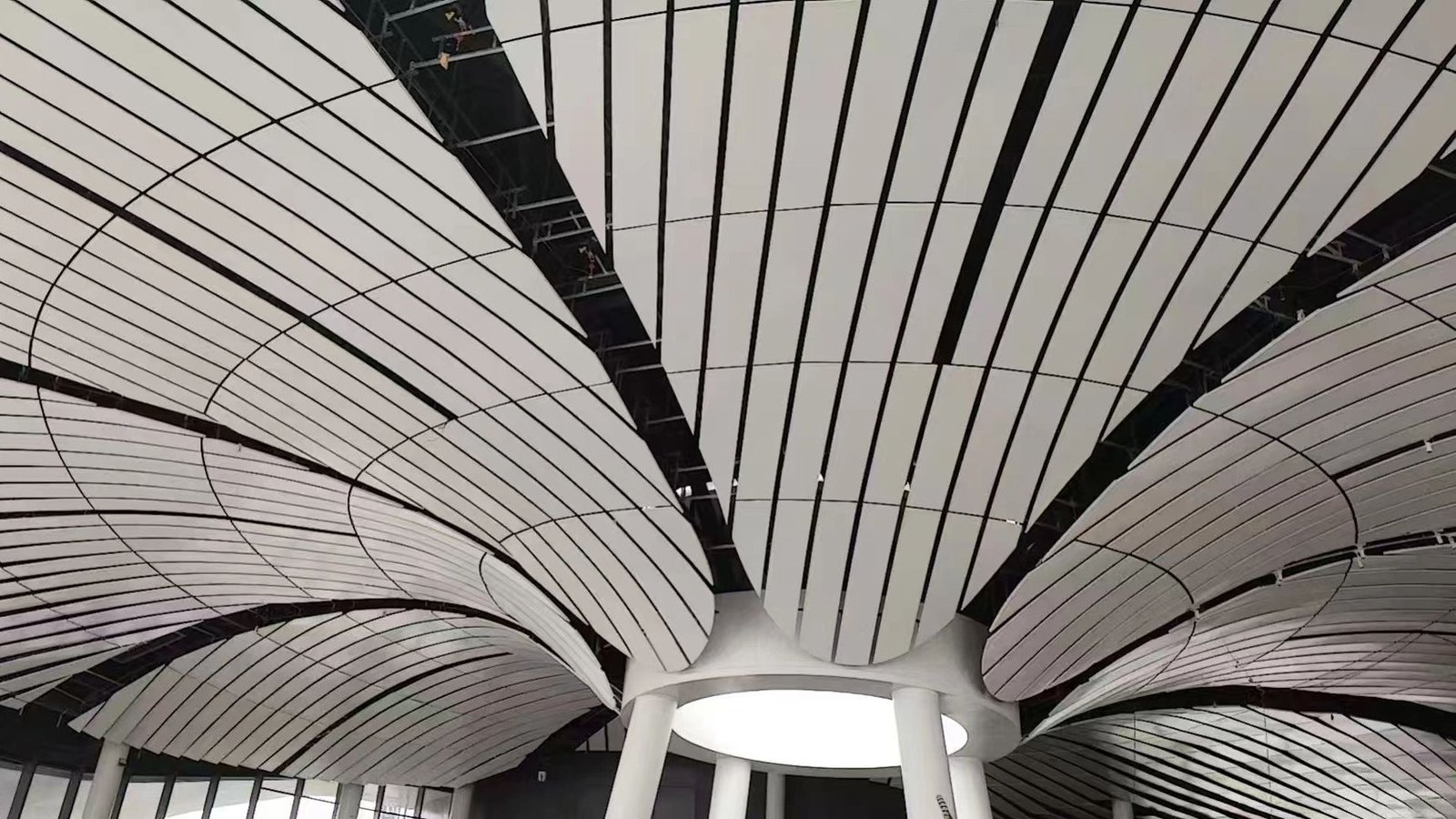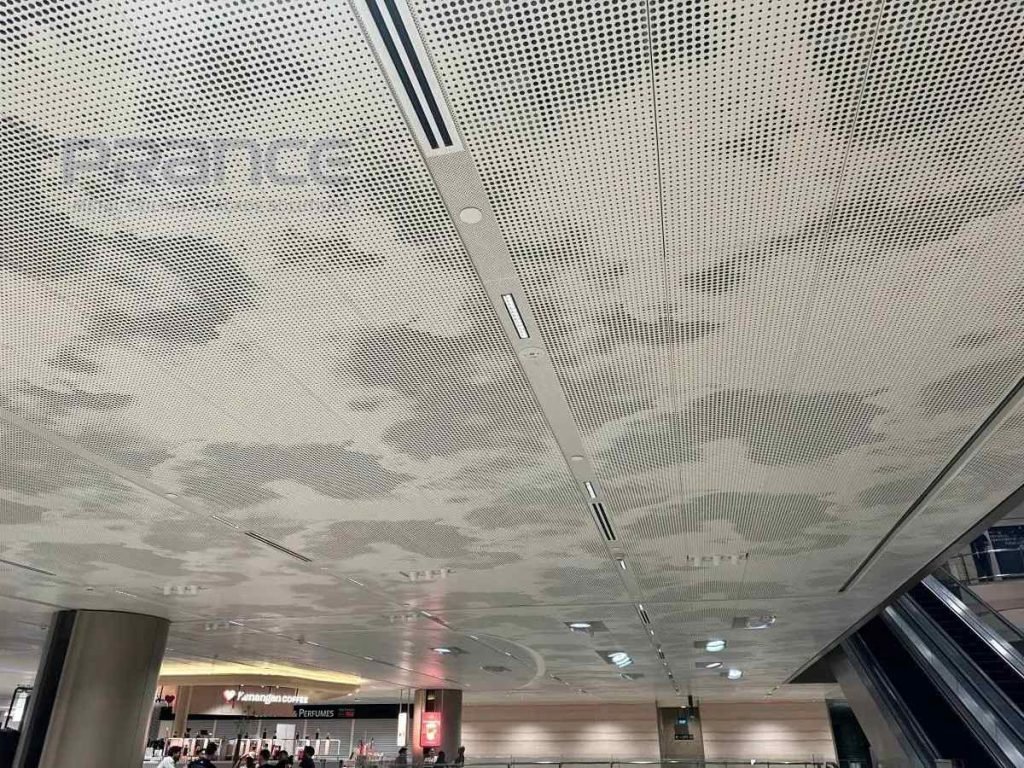
A perforated metal ceiling can help control sound reflections while maintaining the appearance and access advantages of a metal ceiling system. The visible hole pattern is only one part of that decision. Acoustic performance also depends on the backing material, ceiling cavity, panel format, and installed coverage.
For most commercial projects, the practical choice is between a subtle microperforated finish and a more visible standard pattern, followed by a backing selected for the acoustic target and project conditions. The supporting test data should describe the same combination that will be installed. This guide will explain how perforation patterns, acoustic backing materials, panel formats, and test conditions affect the selection of a perforated metal ceiling.
What Gives a Perforated Metal Ceiling Its Acoustic Effect?

Perforations allow sound to pass through the metal face and reach an acoustic fleece, porous infill, or the cavity behind the panel. The backing absorbs part of that sound energy instead of reflecting it directly into the room.
The same perforation pattern can produce different acoustic results with different backing materials. For this reason, acoustic ratings should be checked against the complete tested ceiling system, not the hole pattern alone.
These components help absorb sound within the room, but they do not automatically block sound between adjoining spaces. Projects with room-to-room isolation requirements still need a separate assessment of the partitions, floor, plenum, and ceiling construction.
Which Perforation Pattern Should You Choose?
Pattern Geometry and Open Area
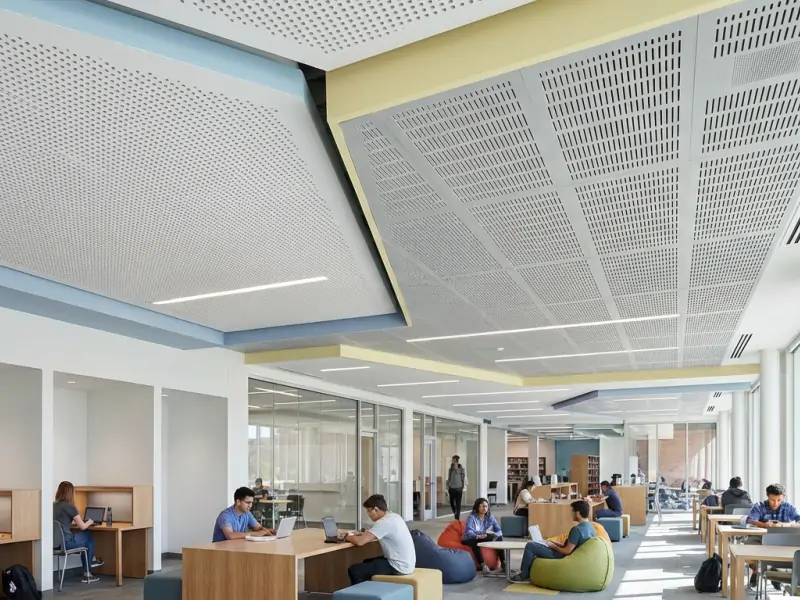
Round holes arranged in straight or staggered rows produce a regular architectural surface. Square and slotted holes create a stronger direction or texture. Custom perforated metal ceilings can introduce gradients, graphics, or changes in pattern density across the ceiling.
Panel edges, joints, folds, and service openings need enough solid metal around them, especially when a custom pattern continues across several panels.
Open area describes the percentage of the panel occupied by holes, but it is only one part of acoustic selection. Hole diameter, pitch, arrangement, backing, and cavity also affect the result. For projects that require tested acoustic performance, use the approved perforation code or record the complete hole geometry and open area.
Microperforated vs Standard Perforations
A micro-perforated metal ceiling provides acoustic treatment while keeping the surface smoother and the perforations less visible. It may work well in offices, meeting rooms, reception areas, and other interiors where the metal finish needs to remain visually restrained.
Standard perforations make the hole pattern more visible, creating a stronger ceiling texture with round, square, slotted, or custom designs.
Neither option is inherently more acoustic. Compare them using tested systems with the proposed backing and cavity. With microperforation, excessive coating build-up can reduce or close the small openings, so the finish needs tighter control.
Which Acoustic Backing Fits the Project?

Acoustic Fleece and Nonwoven Tissue
Acoustic fleece forms a thin layer behind the perforated metal face, making it useful where ceiling build-up is limited or a thicker absorptive pad is not required. Dark fleece can also reduce the visibility of the plenum through the perforations.
Use the backing material, perforation pattern, panel construction, and installation method specified for the selected ceiling system.
Mineral Wool and Glass Wool Infill
Mineral wool or glass wool adds a thicker porous layer behind the panel. Some tested systems use this additional absorptive material instead of a thin fleece layer.
Thickness, density, facing, and position need to match the tested build-up. The project team also needs to consider the additional weight, fiber containment, moisture exposure, fire documentation, and access above the ceiling.
|
Backing option |
Best-fit condition |
Main items to confirm |
|
Acoustic fleece |
Shallow build-up and reduced view into the plenum |
Fleece type, adhesion, perforation, fire data, and acoustic test |
|
Mineral or glass wool |
Tested systems requiring porous infill behind the panel |
Thickness, density, facing, weight, cavity, and fiber containment |
|
Encapsulated infill |
Spaces requiring better control of loose fibers or dust |
Membrane, sealed edges, moisture conditions, and tested performance |
|
Backing-free microperforated system |
Projects requiring minimal material behind the metal face |
Exact microperforation, cavity depth, mounting limits, and system test |
Changing the encapsulation, facing, or cavity depth can change the tested acoustic result.
How Should Acoustic Performance Be Compared?

Confirm NRC Rate
NRC is useful for comparing sound absorption, but the headline value does not tell the whole story. Two perforated metal ceilings with similar NRC ratings can still perform differently across individual frequencies.
For offices, meeting rooms, auditoriums, and other spaces with specific acoustic targets, compare the frequency-band data together with the proposed ceiling coverage, backing material, and cavity depth. These factors give a clearer picture of how the ceiling system is likely to perform in the finished space.
Compare the Complete Ceiling Configuration
Changing the perforation pattern, backing material, cavity depth, or mounting method can change the result. When comparing perforated metal ceiling options, use data that reflects the proposed system as closely as possible, rather than comparing NRC values in isolation.
How Do Material and Panel Format Affect Selection?
Perforated Aluminum vs Steel Ceiling Panels
Aluminum and steel can both be used for acoustic perforated ceilings. Material does not determine the absorption rating alone.
Aluminum reduces panel weight. In humid environments, the alloy, surface finish, and fixings need to match the exposure conditions. While steel offers useful rigidity but requires appropriate coating and edge protection. Choose between them based on panel size, handling, exposure, finish, and suspension requirements, not on an assumed acoustic advantage.
Tile, Plank, and Access Systems
A 600 × 600 metal perforated ceiling tile can coordinate with a modular grid and allow individual panel replacement. Its nominal size does not confirm compatibility; the edge profile and grid system also need to match.
Longer planks or custom panels reduce the number of visible joints but require greater attention to handling, flatness, support spacing, and removal clearance. Lay-in systems normally allow direct downward access, while clip-in and hook-on systems use their own release methods. Select the format with the required visual module and frequency of plenum access in mind.
What Should Be Specified Before Requesting a Quote?
For a perforated metal ceiling quotation, provide the proposed acoustic and visual configuration:
- the acoustic target and applicable test method;
- panel material, thickness, module, edge profile, and finish;
- perforation type, hole diameter, pitch, arrangement, open area, and border;
- acoustic fleece, infill, facing, or encapsulation;
- ceiling cavity, suspension system, and access method;
- relevant fire or environmental requirements.
For custom perforations, include the panel layout, pattern direction, edge zones, and major MEP openings on the RCP. A finished sample can confirm the perforation scale, coating quality, color, and backing visibility before the design is released for fabrication.
Choose the Pattern and Backing as One System
Standard perforations keep the hole pattern visible, while microperforation creates a smoother metal surface. Acoustic fleece allows a thinner build-up; mineral wool, glass wool, and encapsulated infill serve different acoustic and environmental requirements.
The selected perforation, backing, cavity, panel format, and suspension need to correspond with the acoustic data used for the project. For project review or quotation, provide the RCP, acoustic target, preferred pattern, finish, and site conditions.
Conclusion
A perforated metal ceiling works best when the perforation pattern, backing material, ceiling cavity, panel format, and suspension system are considered together. Standard perforations create a more visible pattern, while microperforation gives the ceiling a subtler surface. The selected system also needs to match the project’s acoustic target and installation conditions.
Planning a perforated metal ceiling for your project? Explore PRANCE’s metal ceiling solutions or contact our team with your RCP, acoustic requirements, preferred panel format, and finish for a project-specific review.
FAQs
Do Perforated Metal Ceilings Always Need Acoustic Backing?
No. Many systems use acoustic fleece, mineral wool, or other porous backing to improve sound absorption, but some microperforated ceilings can work without a separate backing layer. Always compare the acoustic data for the complete ceiling system.
Does a Higher Open Area Always Improve Acoustic Performance?
No. Open area is only one factor. Hole size, spacing, backing material, cavity depth, and overall ceiling construction also affect sound absorption. Compare tested systems instead of judging performance by open area alone.
How Should MEP Services Align with Custom Perforations?
Coordinate cut-outs, joints, service centers, and access zones on the RCP before pattern approval. Keep perforations clear of lights, diffusers, speakers, and sprinklers to avoid partial holes and weak panel edges.
Can Sensitive Spaces Use Fiber-Free Acoustic Backing?
Yes. Acoustic fleece, encapsulated infill, or a tested backing-free microperforated system may be used where acoustic, fire, hygiene, and environmental requirements allow. Check each option as part of the complete ceiling system.